
The Science of Taste
What Is Taste?
The way we perceive taste is quite distinctive compared with other sensory stimuli because taste is only perceived after an external substance (food) has been selected and ingested, thus brought into contact with the gustatory system. In contrast, the physical sources of visual, auditory, somatosensory, and olfactory stimuli are external to the organism.
We can see objects from nearby and far away, hear sounds from a distance, feel stimuli that come into contact with our bodies, and detect airborne molecules originating from objects in the environment. Gustatory perception, however, requires a more active and deliberate interaction with the external world—selection and ingestion of known and unknown substances and liquids and only then provides sensory information (1). However, the combined action of those senses (mechanoreception, vision, olfaction, and gustation) allows humans and other mammals to assess the sensory and physical properties of potential food resources, helping them distinguish nutritionally valuable and edible foods from inedible or potentially harmful ones1. Taste stimuli are perceived only after they are ingested.
Our sense of taste acts as the final sensory checkpoint, providing a rapid evaluation of the chemical components of food in the oral cavity before swallowing and ingestion (2).
We tend to use the word taste whenever we experience a dish to describe its qualities. We say a dish we had was with “good-tastе” or the food we ate was too salty or too sweet. Sometimes we use the word to describe how that a spice we have put into a dish has changed the taste of the meal. While we eat, we can define some of the tastes that we are sensing as salty, sweet, sour, bitter, or umami (savory). If we think about it, taste is much more specific than the overall experience that we usually call “taste”.
Taste or gustation is the sensory process of detecting chemical compounds, called tastants, that are released when we chew food. They are then dissolved in saliva and interact with specific molecules in our mouths which can elicit a specific response that will be processed by our brain as taste. In humans the oral cavity is equipped with sensors that can detect the nutritionally relevant molecules through the five basic taste qualities which are salty, sour, sweet, bitter and umami [for Jap. delicious]. Those five major categories of taste quality are each capable of detecting a particular nutrient that is essential for survival – water balance (salty), monitoring acidity (sour), energy intake and reserves (sweet), avoiding toxins (bitter) and protein intake (umami).
Taste Is Not the Same as Flavor
One of the most common misconceptions in food science is treating taste and flavor as synonyms.
They are actually not.
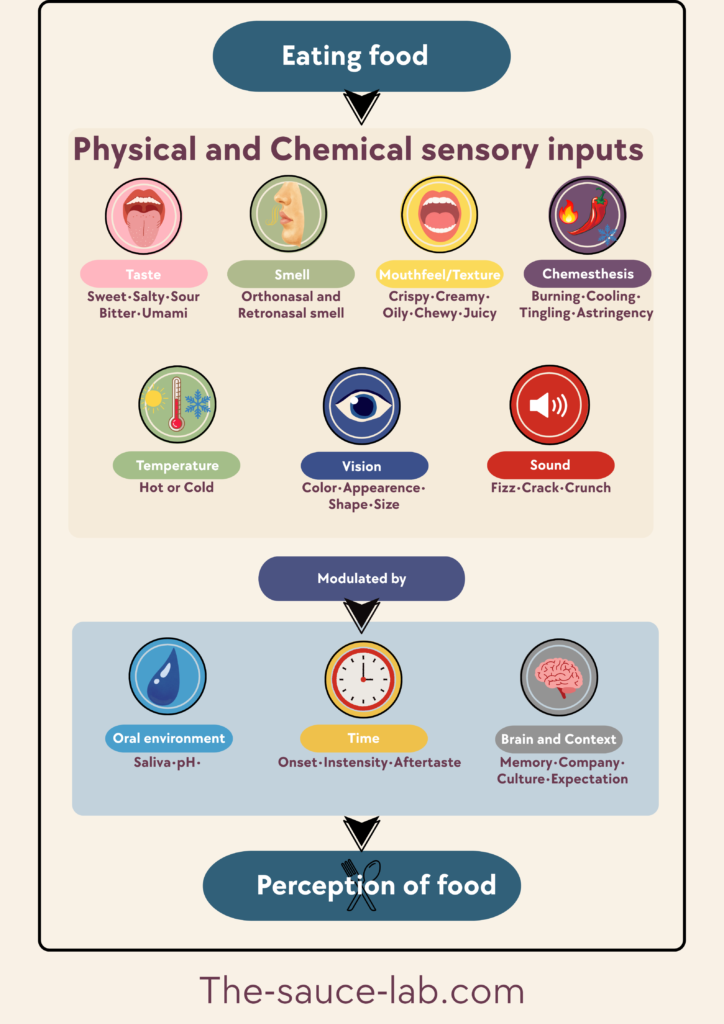
Let me ask you something. Can you describe millions of dishes and thousands of cuisines out there just by using those five basic tastes? The short answer is no. The characteristic of those foods and how we perceive them is not just the work of our taste buds. The unique taste of food is a combination of the five tastes and thousands of different odorants that are passed from the mouth through a narrow air-passage shunting to the nasal olfactory mucosa while we chew food or drink a beverage. This ability to perceive the flavor dimension of food and drinks is called retronasal olfaction*. Orthonasal smell or just smell is the perception of odors when volatile molecules enter the nose through the nostrils from the external environment. While the five basic tastes—sweet, sour, salty, bitter, and umami—provide fundamental taste sensations, distinguishing the characteristic flavor of an apple from that of a pear relies heavily on retronasal olfaction.
Beyond Taste and Smell
Experiencing food is much more complicated than basic tastes and retronasal olfaction. Let’s do a mental experiment.
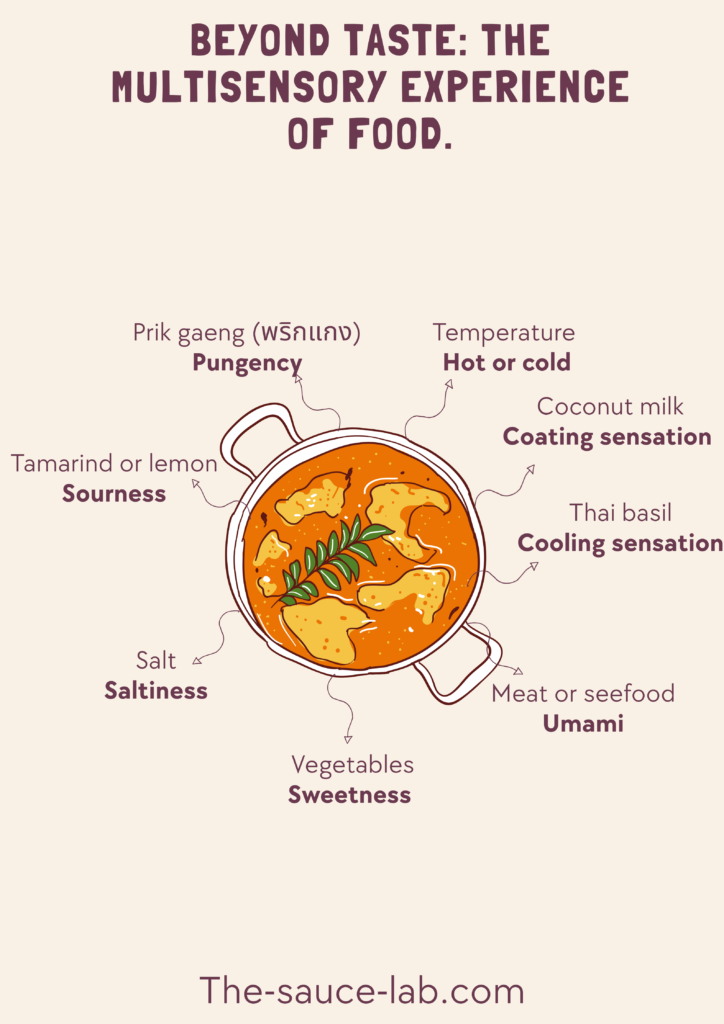
Imagine that you eat a spicy Thai curry with coconut milk and fresh herbs. While you eat it, you will immediately experience several sensations that go far beyond the five basic tastes. One of the ingredients of a good Thai curry is Prik gaeng (พริกแกง), or chili paste. This component of the dish will produce a hotness or burning sensation in your mouth through pungency, while the coconut milk will provide a rich, coating sensation which is contributed by the fat. The fresh Thai basil in the dish will create a subtle sensation of cooling, while the herbs and spices when chewed will release volatile molecules that contribute to the food’s aroma through retronasal olfaction. Depending on how it is served, hot or cold, you are also going to notice the temperature in your mouth. If the curry contains ingredients such as tamarind or lime, they contribute sourness, saltiness from the salt that is added, sweetness from the vegetable used and umami if it’s cooked with meat or seafood. Certain plant compounds can produce astringency, leaving your mouth feeling dry. The texture of the vegetables, herbs, and other ingredients used for the preparation of the dish will add yet another dimension to your eating experience, which is called texture. If you pair the curry with a carbonated drink, the dissolved carbon dioxide produces the characteristic tingling in your mouth. This is why when you eat something it does not taste simply “sweet + sour”. Its characteristic flavor is the result of many sensory signals being processed together by the brain. Thus, eating can be said to be a multisensory event in the mouth.
In general, those additional modalities (excluding taste and olfaction) that we can perceive while consuming food and drinks involve other sensory systems, including the somatosensory and trigeminal ones.
Together, all of these sensations contribute to what we commonly describe as the “taste” of the meal, even though many of them are not tastes at all.
The Taste Bud: Where Taste Begins
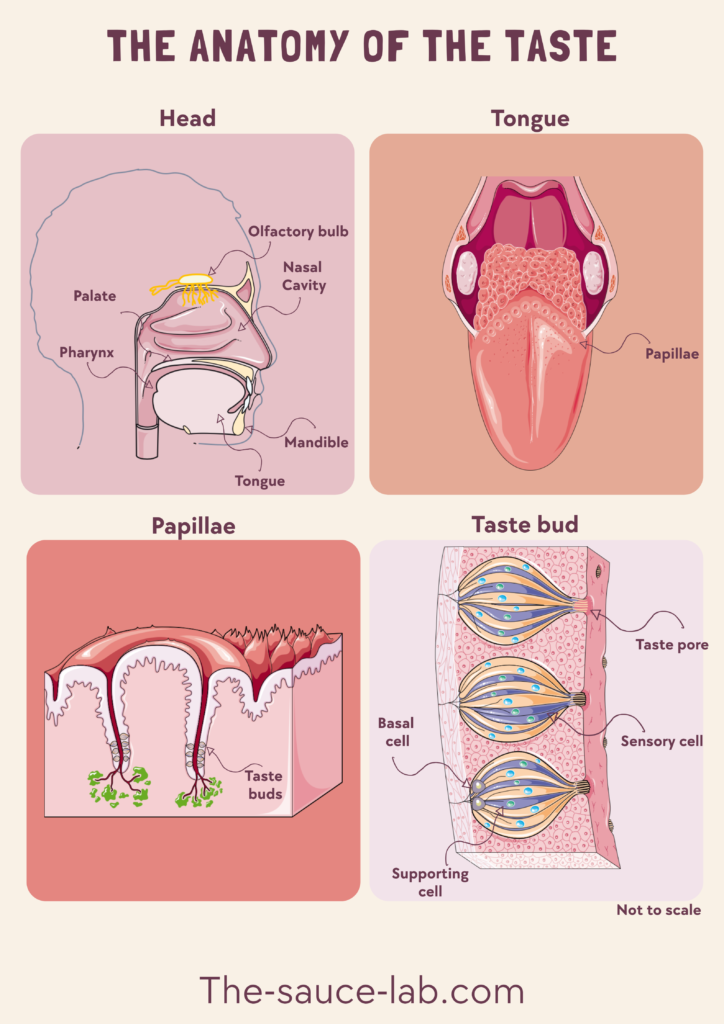
Taste buds location
Taste is a chemical sensation which is elicited by various chemicals acting on a specialized cell. Those cells are organised into structures called taste buds. Taste buds are distributed throughout the oral cavity and upper pharynx, with the highest concentration occurring on the tongue. Structures like the soft palate, oropharynx, and epiglottis also contain taste buds. The anterior two-thirds of tongue in combination with the anterior portion of the palate is related to general taste identification. The posterior portion of the tongues is related to reflexes associated with ingestion and rejection of food, whereas those located in the epiglottis are related with airway protection (3,4).
The taste buds are located in specific structures of the epithelium of the tongue termed lingual papillae. There are four types of lingual papillae: filiform, fungiform, circumvallate, and foliate. From those only the highly keratinized, rough-surfaced ones, called filiform papillae do not contain taste buds. They help with additional mechanical manipulation and handling of food during mastication.
Taste buds structure
When we look closer, we can appreciate that the taste bud is an oval body that contains a collection of small specialized epithelial cells. A typical taste bud will contain roughly 50–100 cells organized in a structure resembling a small bulb. On the surface of the taste bud an opening called the taste pore can be found. The cells inside the bud do not perform the same tasks. Functionally they fall into 3 types (Type I, II, III) according to their structure and function. An additional cell type (IV), able to restore them all, can also be found in the structure (5).
Type I cells, also called supporting cells, are less numerous than the sensory cells. They are long, spindle-shaped cells and are responsible for the physical and mechanical support for the rest of the sensory cells (5).
Neuroepithelial cells (type II and III cells) are the most numerous and are responsible for perceiving and conveying information about taste to the brain. They are elongated and extend to the taste pore. On their superior surface they contain brush-like structures called microvilli. At their base they contact cranial nerves (CN VII, IX, and X) that help communicate the signal to the brain. They are relatively short-lived – approximately 10 days (6). Based on their function, chemosensory cell in the taste bud can be subdivided into two broader categories. Approximately 1/3 of the cells in the taste buds are type II cells, which function as receptors for sugars (sweet), amino acids (umami) and/or bitter compounds. Those cells perceive the stimuli via specialized structures called receptors. Additionally, a taste bud can contain multiple type II cells, each able to react to more than one tastant and taste stimuli (5).
Type III taste cells are fewer than type II cells and comprise approximately 2-20% of the cell population in the taste bud. Their location withing the oral cavity varies, with very few cells present in the anterior portion of the tongue, and much more in the posterior portion of the tongue. Their main function is to detect sour taste (5).
So, what about saltiness? Which cells can recognize salt as a stimulus and send the information to the brain? Saltiness is not detected by a single cell type, but rather the concentration of salt (low vs high) determines which cell is activated and which cellular pathway is recruited (7).
Basal cells (type IV cells) are located in the inferior portion of the taste bud. Functionally they are stem cells, a type of unspecialized cell able to replenish the other two cell types discussed above (5).
We will explore all these cells and their intricate mechanisms of action in the subsequent posts of the series.
From the Tongue to the Brain
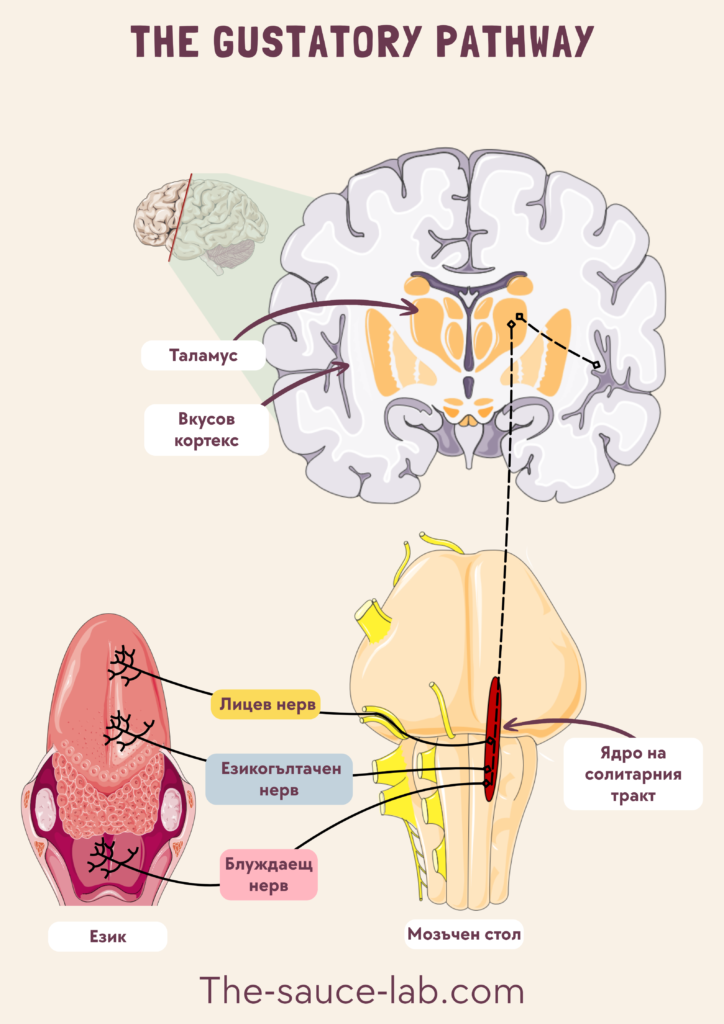
Taste sensations start when a taste bud sensory cell detects a stimulus. The information about this stimulation is transmitted by cable-like structures called cranial nerves, e.g. facial (VII), glossopharyngeal (IX) and vagus (X) nerves. Facial nerve (VII) will receive signals from the anterior most portion of the tongue, while glossopharyngeal nerve will receive information from the posterior portion of the tongue. Vagal nerve will be responsible for taste buds located outside of the tongue, in places such as the soft palate and epiglottis2. The information will be transmitted to a small bulblike structure (ganglion) before going to the brain stem which is responsible for important basic body functions. Additionally, sensations related to the mechanical and thermal properties of the food and liquids that we ingest, alongside some irritants like piperin in black pepper or gingerol in ginger, are conveyed to the brain by yet another cranial nerve called the trigeminal nerve (V).
The three cranial nerves—VII, IX, and X—will transmit the sensory information to a specific portion of the brainstem called nucleus of the solitary tract (NTS) which is responsible for handling the taste sensations. NTS is responsible for food-related reflexes such as salivating, chewing, licking, swallowing, belch reflex, gag reflex, as well as facial responses to taste stimuli. In this region a decision is made to accept and ingest a sweet taste, but to reject a strong bitter taste.
NTS also receives projections from brain regions involved in sensory processing, cognition, emotion, reward and energy homeostasis. These connections can affect how we process the experience of taste based on previous experiences, hedonic values or the organism metabolic state.
After NTS, the information for the taste is caried to the higher brain regions with the final destination being the gustatory cortex. Additionally, information is also sent to the almond-shaped structure (amygdala) in the brain involved in emotional and motivational aspects related to the tasted food—deciding and learning if the taste is pleasant or unpleasant. Another structure that NTS sends information to is called the hypothalamus, which is related to hunger, feeding behavior and energy balance (8).
One taste one signal
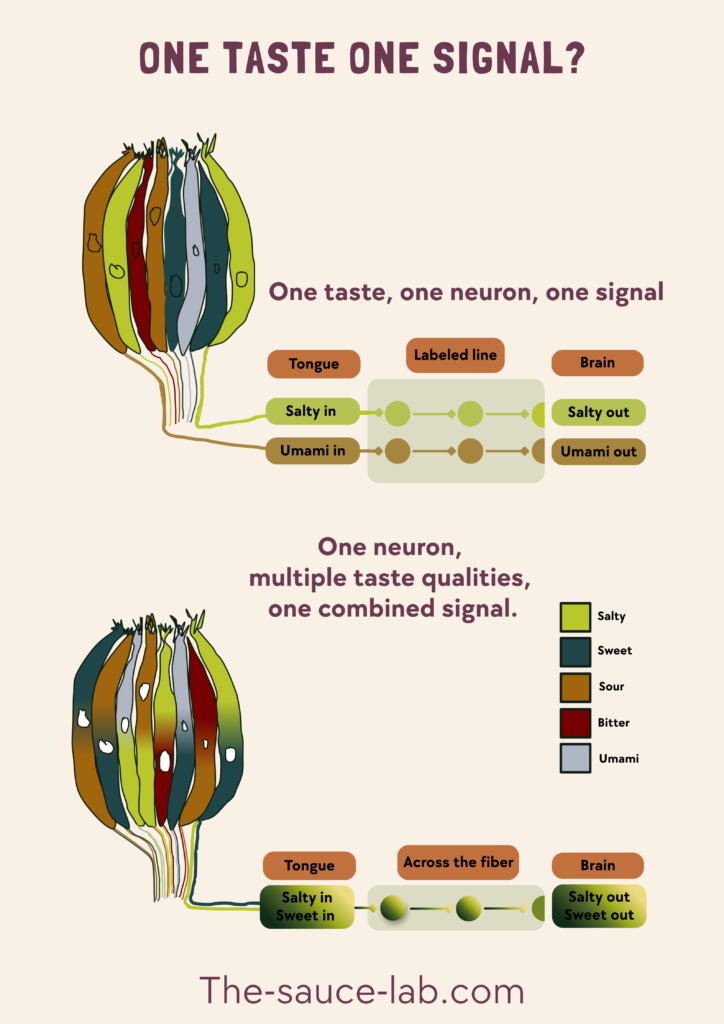
How the signals travel to the brain is easy, but how those signals are read by the brain is a little bit more complicated. How does the brain represent taste? Scientists have two main theories of how taste is decoded in the brain.
The basic structural unit of the brain, the neurons, can respond to more than one taste quality.
Labeled-line theory
The fist theory is called the labeled-line theory, and it is pretty straightforward. We can imagine that each neuron responsible for taste has a label. Just for simplicity we can say that one neuron responds only to sweet, one only for salty and so forth. This can be simplified as the following (9):
sweet stimulus → sweet line → brain decodes that as “sweet”
bitter stimulus → bitter line → brain decodes that as “bitter” and so on.
Across the fiber coding system
The other model, called across the fiber coding system, does not assume a one-taste–one-neuron relationship, but rather a presence of a specific pattern of neuronal activity. This theory doesn’t look at one neuron at a time, but the activity of the whole population. The combination of neuronal activity across multiple neurons will tell the brain that a particular activity should be categorized in the brain as sweet for example. You can imagine it a barcode. A barcode isn’t recognized by price scanner just because of one particular line, but is identified by the whole pattern.
Interestingly neurons that are specialized at responding to a particular taste quality are named SPECIALISTS, while GENERALISTS can respond to more than one taste, thus they are not tuned to recognize only one. Let’s give examples with three known types of neurons: S-specialists, N-specialists, and E-generalists. The S neurons are able to recognize sucrose or other sweet compounds and they respond little to none to other chemicals such as NaCl (salt), HCl (sour) and quinine (bitter), while N neurons respond preferentially to Na+ and Li+ salts and are less or not at all responsive to non-sodium stimuli. Those two are examples of neurons specialist. On the other hand, there is a neuron, the E-generalist, which reacts best to HCl (sour), but they do not react only to sour, but also NaCl (salt), quinine (bitter) and other electrolytes.
HCl ↑↑↑ → NaCl ↑↑ → quinine ↑ → other electrolytes ↑
Some authors argue the presence of both specialist and generalist can support both labeled-line and across-fiber coding system, rather than relying on one theory to explain it all (10).
The role of saliva for tasting
Saliva is a digestive fluid that is secreted by the three major salivary glands (parotid, submandibular and sublingual), but also by numerous minor glands located in different parts of the oral cavity. The enzymes found in the saliva are the ones that will begin the process of digestion of some complex carbohydrates such as starch. Saliva also aids with lubrication, protection of the mucosa in the mouth from drying out, wetting of food and in formation of the food bolus. Furthermore, saliva participates in the taste transduction by dissolving the taste stimuli and then passing them towards the taste receptor. But what about tastes locked in in oils and fats? Saliva does more than simply dissolve taste molecules—it can emulsify oils and fats, helping bring otherwise fat-soluble compounds into contact with the taste buds. Interestingly, the proteins (whey and lysozyme) stabilizing these emulsions can also change how oil and fats feel in the mouth, from smooth and creamy to persistent and almost astringent. The mechanism of action the difference in the mouthfeel is that the emulsions stabilized by whey protein interact less with the tongue, giving a smoother, creamier feel, while the lysozyme-stabilized emulsions tend to interact more with the tongue, which we can feel as an astringent-like sensation (14).
Why Do We Experience Taste?
By experiencing taste, animals and humans alike, can figure out if a particular food is a good source for nutrients that they need, but also gives them the advantage of recognizing a potentially hazardous toxin. The presence of those five basic tastes will ensure all the dietary need for the organism. Sweet will ensure the presence and right amount of energy in the form of carbohydrates. Umami will ensure the presence of another building block and essential component for the organism– proteins. Ingestion of salt will ensure the proper electrolyte balance through ingesting of ions such as sodium that are essential for physiological function. Sour taste in most animals is aversive and will discourage the ingestion of spoiled food. Bitter will prevent the organism of ingesting noxious, toxic chemicals you can find throughout nature (2). So, one can argue that the main purpose of the taste system is to allow a species to be attracted to food items that are needed for its survival and avoid those that will most likely kill it.
Are all animals capable of detecting the 5 basic tastes?
To survive, different species have evolved distinct feeding strategies. Depending on their diets, animals can be classified as omnivores (animal that eats both plant and animal matter), carnivores (mainly consuming meat), or herbivores (solely on plant tissues). These dietary adaptations are often accompanied by differences in taste perception, and some species have lost the ability to detect certain taste qualities as a result of their specialized diets.
There are quite a few examples of species that have lost taste due to the specificity of their diet or habitat. For example:
- Koalas (Phascolarctos cinereus) are marsupials whose main source of energy is eucalyptus leaves. Those leaves contain large amounts of secondary-metabolite toxins such as terpenes, phenols and glycosides. For this reason, koalas have more bitter taste receptors than any other marsupial, most probably helping them choose the “better,” less toxic leaves out there. Even though there is little to no protein or sugars in eucalyptus leaves, koalas have retained their umami and sweet taste receptors (12).
- The giant panda (Ailuropoda melanoleuca), despite being taxonomically classified as a carnivore, its diet is mainly composed of bamboo and bamboo shoots. Three main changes occurred in the taste genes in the giant panda. (I) They have lost the ability to taste umami due to pseudogenization the receptor gene for it (Tas1r1) (13); (II) bamboo has little to no sugar, but they still have functional sweet taste receptors (14); (III) Pandas have more functional genes for bitter taste receptors than other carnivores (14) most probably because of the abundance of bitter compounds such as phenolics, terpenoids, alkaloids, flavonoids and cyanogenic glycosides in the bamboo plant (15, 16).
- Domestic cats (Felis catus) are small mammals that people have domesticated 10,000 years ago (17). They are an obligate carnivore that possess an otherwise functional sense of taste, but is unable to detect sweetness.(18,19)
Thus, taste sensations are not perceived in the same way by every mammal. A taste that is essential to one species may be irrelevant to another. Throughout evolution, dietary specialization has been accompanied by changes in the gustatory system, leading to the preservation of useful taste sensitivities and the loss of others that are not needed. In this way, taste reveals how evolution shapes sensory perception around an animal’s ecological niche.
Final Thoughts
Taste may seem like a simple sense, but it’s quite complex. We put something in our mouths, and it tastes sweet, salty, sour, bitter or umami. But behind those 5 basic tastes sits a complex biological system governed by the need for energy, avoidance of harmful substances, and evolution. Taste molecules will interact with specific receptors and will transform the chemical information into neural signals. Those signals will travel towards the brain, which will combine all the information about the ingested food – how it looks, how it smells, what is the texture and the result is what we experience as food.
This is where brain science becomes useful in the kitchen. Once we understand how we perceive taste, only then can we start asking questions such as:
- Why does salt make food taste more pleasant?
- Why does sugar balance acidity?
- Why does fermentation create such complex flavors?
- Why does food containing MSG taste better?
- Why does food taste different when we have a cold?
- Why can the same dish taste different to two people?
- And why can a tiny amount of one ingredient completely change the perception of an entire meal?
These are the questions we will explore next.
Welcome to the science of taste.
References
- Gottfried, J. A. (Ed.). (2011). Neurobiology of sensation and reward. CRC Press.
- Behrens, M., & Lang, T. (2022). Extra-oral taste receptors—Function, disease, and perspectives. Frontiers in Nutrition, 9, Article 881177. https://doi.org/10.3389/fnut.2022.881177
- Roper SD, Chaudhari N. Taste buds: cells, signals and synapses. Nat Rev Neurosci. 2017;18(8):485–497. doi: 10.1038/nrn.2017.68
- Chaudhari N, Roper SD. The cell biology of taste. J Cell Biol. 2010;190(3):285–296. doi: 10.1083/jcb.201003144
- Finger TE, Barlow LA. Cellular diversity and regeneration in taste buds. Curr Opin Physiol. 2021;20:141–147. doi: 10.1016/j.cophys.2021.01.003
- Perea-Martinez I, Nagai T, Chaudhari N. Functional cell types in taste buds have distinct longevities. PLoS One. 2013;8(1):e53399. doi: 10.1371/journal.pone.0053399
- Chandrashekar J, Kuhn C, Oka Y, et al. (2010). The cells and peripheral representation of sodium taste in mice. Nature, 464, 297–301. https://doi.org/10.1038/nature08783
- Bradley, R. M. (Ed.). (2007). The role of the nucleus of the solitary tract in gustatory processing. CRC Press.
- Chandrashekar J, Hoon MA, Ryba NJP, Zuker CS. The receptors and cells for mammalian taste. Nature. 2006;444(7117):288–294. doi: 10.1038/nature05401
- Frank ME, Lundy RF Jr, Contreras RJ. Cracking taste codes by tapping into sensory neuron impulse traffic. Prog Neurobiol. 2008;86(3):245–263. doi: 10.1016/j.pneurobio.2008.09.003
- Matsuo, R., & Carpenter, G. H. (2015). The role of saliva in taste transduction. In R. L. Doty (Ed.), Handbook of olfaction and gustation (3rd ed., pp. 623–636). Wiley-Blackwell. https://doi.org/10.1002/9781118971758.ch28
- Johnson RN, O’Meally D, Chen Z, Etherington GJ, Ho SYW, Nash WJ, et al. Adaptation and conservation insights from the koala genome. Nat Genet. 2018;50(8):1102–1111. doi: 10.1038/s41588-018-0153-5
- Zhao H, Yang JR, Xu H, Zhang J. Pseudogenization of the umami taste receptor gene Tas1r1 in the giant panda coincided with its dietary switch to bamboo. Mol Biol Evol. 2010;27(12):2669–2673. doi: 10.1093/molbev/msq153
- Jiang P, Josue-Almqvist J, Jin X, Li X, Brand JG, Margolskee RF, et al. The bamboo-eating giant panda (Ailuropoda melanoleuca) has a sweet tooth: behavioral and molecular responses to compounds that taste sweet to humans. PLoS One. 2014;9(3):e93043. doi: 10.1371/journal.pone.0093043
- Bai C, You Y, Liu Y, Xu H, Zhang Y, Shan G, et al. Feeding preferences of giant pandas may reflect the detection of specific volatiles and bitter-tasting metabolites in bamboo leaves as markers of nutritional status. Plants (Basel). 2025;14(24):3856. doi: 10.3390/plants14243856
- Shan L, Wu Q, Wang L, Zhang L, Wei F. Lineage-specific evolution of bitter taste receptor genes in the giant and red pandas implies dietary adaptation. Integr Zool. 2018;13(2):152–159. doi: 10.1111/1749-4877.12291
- Driscoll CA, Clutton-Brock J, Kitchener AC, O’Brien SJ. The taming of the cat: genetic and archaeological findings hint that wildcats became housecats earlier—and in a different place—than previously thought. Sci Am. 2009;300(6):68–75. PMID: 19485091
- Li X, Li W, Wang H, Bayley DL, Cao J, Reed DR, et al. Cats lack a sweet taste receptor. J Nutr. 2006;136(7 Suppl):1932S–1934S. doi:10.1093/jn/136.7.1932S.
- Li X, Li W, Wang H, Cao J, Maehashi K, Huang L, et al. Pseudogenization of a sweet-receptor gene accounts for cats’ indifference toward sugar. PLoS Genet. 2005;1(1):27–35. doi:10.1371/journal.pgen.0010003.
- Figures are made using Canva and ServierMedicalArt- SMART – Servier Medical ART
- Selecting food is influenced not only by the sensory properties of a stimulus and previous experience, but also by the organism’s internal physiological state. Through learning, animals can associate particular foods with beneficial or harmful consequences, thereby modifying their future feeding choices. We should also point out that at any given moment, the metabolic state (e.g., whether it is satiated or food-deprived) can overrule the learnt experience of the probable qualities of the food.For example, I can show extremely strong preference for a chocolate bar after a long run (hungry; food-deprived), but consume considerably less of the same favourite chocolate bar when satiated, despite retaining its ability to recognize the sweet taste and previous positive association. This state-dependent modulation of food preference, known as alliesthesia, illustrates how internal metabolic signals can modify the hedonic value of sensory stimuli and influence feeding behaviour. ↩︎
- Small, leaf-like flap of elastic tissue acting as a valve, blocking food and liquid from entering the windpipe during swallowing. ↩︎