
Culinary Stocks: Types, Techniques & Tips

What is a stock?
A stock is a flavourful extract made by cooking meat, vegetables, and fish in water. Stock is more or less an extraction process. Its purpose is to draw out the nutritive and flavourful compounds out of the cooked products. Flavour extraction, in my opinion, is as important as collagen extraction and gelatine production. Heating collagen will be converted to gelatine, which when cooled, will form gels, giving the stock a smoother, richer texture, improving the mouthfeel—one of the factors for flavour.
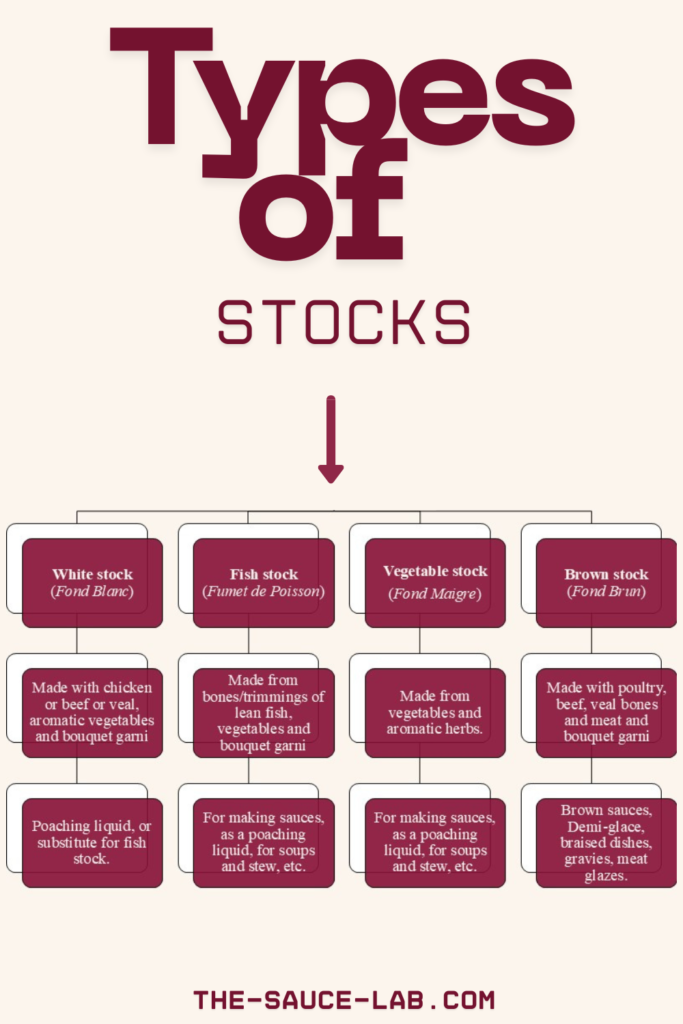
Traditionally, stock can be divided broadly into four main categories: white, brown, vegetable, and fish stock.
White stocks are usually prepared by blanching meat and bones and then simmering them with cold water for a short time.
Brown stocks are prepared by first browning the bones and meats, in the oven or on top of the stove, and then simmering them in cold water.
Types of Stock
There are four basic kinds of stock (fonds): white stock (Fond Blanc), brown stock (Fond Brun), fish stock (Fumet de Poisson), and vegetable stock (Fond Maigre). This classification deals with preparation of the ingredients and, to some extent, the colour.
a. White Stock (Fond Blanc)
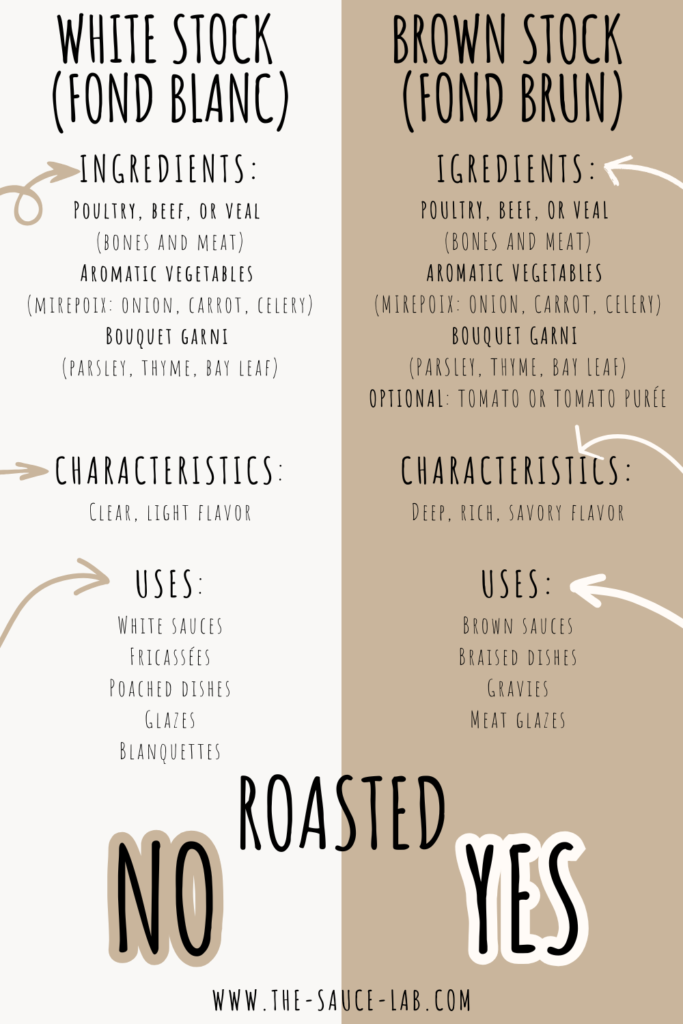
White stock is made with chicken (meat, bones, or carcasses) or beef (meat or bones), veal (meat or bones), aromatic vegetables (mirepoix), and bouquet garni (parsley, thyme, and bay leaf).
Preparation:
- Smell the bones/meat and make sure that they are fresh.
- Trim as much fat as you can (this will help with keeping the stock clear).
- Optional: The meat/bones can be first blanched and washed with cold water to remove impurities and produce clearer stock.
- Bones or meat are placed in a pan, covered in cold liquid, and slowly brought to a simmer.
- Mirepoix is added to the pot. (Optional: They can be sautéed beforehand.)
- If impurities rise to the top, they are removed.
- The mixture is gently simmered until finished.
They can be used in the following recipes:
White sauces, fricassées, poached dishes, glazes, and blanquettes.
b. Brown Stock (Fond Brun)
Brown stock is made with poultry, beef, veal bones, and meat.
Preparation:
- Bones are roasted until golden brown in an oven or on the stove. They should be golden and not burnt.
- Mirepoix can also be roasted together with the meat and bones. To increase the umami and savouriness, tomato or tomato purée may also be added.
- The bones and meat, together with the vegetables, are simmered gently.
Uses:
Brown sauces, braised dishes, gravies, meat glazes.
c. Vegetable Stock (Fond Maigre)
Stock made from vegetables and aromatic herbs.
Preparation:
- Vegetables are sautéed gently in butter.
- The vegetables and the aromatic herbs are added to a pot.
- Cold water is added, and the mixture is simmered for a short period of time.
Uses:
Poaching liquid or substitute for fish stock.

d. Fish Stock (Fumet de Poisson)
Fish stock (fish fumet) is prepared from bones and trimmings of lean fish such as sole, flounder, turbot, brill, etc. It is not recommended to use oily fish—salmon, mackerel, sardines, bluefish, tuna—except for the preparation of red wine sauces. It is preferable to make the stock as soon as the fish is filleted and to wash and soak the parts that are going to be used in cold water for a couple of hours to remove impurities. When preparing the bones and trimmings for the stock, make sure to remove the guts, skin, and gills.
Preparation:
- Smell the bones and trimmings. If they don’t smell good, discard them.
- Remove the guts, gills, and skin.
- Wash and soak them for a couple of hours in cold water.
- Dice finely the vegetables and sweat them in butter, then add the fish trimmings or bones. Cook for a couple of minutes.
- Add cold water and white wine, bring to a simmer, skim the fat and impurities, add bouquet garni, and continue simmering for 20 minutes.
Uses:
For making sauces, as a poaching liquid, for soups and stews, etc.

Ingredients for Stock
1. Bones
Bones are the primary source of flavour and body in stock.
Stocks are typically made from:
- Brown and White Chicken stock: chicken bones.
- Brown and White Beef stock: beef or veal bones (sometimes with small amounts of chicken or pork).
- Fish stock: fish bones and trimmings.
- Vegetable stock (Fond Maigre): red/white onions, carrots, celery, garlic, fennel, white wine.
- Other stocks: game, lamb, poultry, etc.
2. Meat
Meat is rarely used because of its cost, but simmered meat or poultry alone can produce a flavourful broth.
Broth: A liquid made by simmering meat and vegetables.
3. Mirepoix
A flavour base made from vegetables such as onions, carrots, and celery.
4. Acidic Ingredients
Acids help break down connective tissue and enhance flavour extraction.
- Tomato products: Add flavour and acidity to brown stocks (not used in white stock).
- Wine: Occasionally used, especially in fish stocks, mainly for flavour.
5. Scraps and Leftovers
Stock quality depends on the ingredients used—”Garbage in, garbage out” (GIGO).
6. Seasonings and Spices
- Salt: Usually omitted, as if the stock is reduced it will become very salty.
- Herbs and spices: Added lightly to avoid overpowering the stock. They are often placed in a sachet (cheesecloth bag) for easy removal.
- Bouquet garni: A sachet containing herbs only (parsley, thyme, bay leaf), without spices.
Things to Consider When Making Stocks
8 Rules for the Perfect Stock

Group 1 – Clear, Not Cloudy Stock
1. Start always with cold liquid
Always start the preparation of any stock with cold liquid. This will prevent the quick release of soluble proteins in the liquid, most notably albumin. Using hot water will coagulate those proteins into very small particles, which will lead to a cloudy stock. Using cold water will allow for gradual release and coagulation of proteins; they will float on the surface of the stock where they can be skimmed. The same applies if you want to top off to compensate for evaporation.
2. Keep it in one place
When you simmer your stock, make sure not to move the pot. While some of the proteins will float on top and can be skimmed, some of them will settle at the bottom and sides of the pot. Moving the pot or stirring will cause them to break up, which will lead to cloudy stock. The same principle applies when you strain the final product. Be very gentle with it; don’t press into the solids or stir them. If you do that, it will unclamp that protein and they will end up again in the stock.
3. Simmer, rather than boil
While bones and meat are cooked, they release proteins and fat. Boiling will cause emulsification between them but also will disturb the settled proteins and fat from the sides and the bottom, creating cloudy and greasy stock. Simmering keeps the impurities on the top of the solution from where they can be skimmed. A very good practical advice is to set the pot off-centre on the stove or burner; that way the impurities will float and gather only on one side of the pot. Rule of thumb is to skim every 5–10 minutes in the first few hours and then every 30–60 minutes.
4. Clear instruments
Keep the ladle/strainer you are using cold, so the proteins and lipids don’t cake on it.
Group 2 – Flavour
5. Dilution
Add just enough water to cover your ingredients. Don’t add too much; it will dilute the flavor of the stock. The rule of thumb is to add as much water as needed to cover the ingredients used for the stock. The only exception: if you cook the stock for prolonged periods of time, you can top it off with cold water.
6. Keep the delicate aromas
Overreducing will concentrate the flavour, but it will kill the delicate taste and aroma. Reduce until the flavour is bright and balanced—not flat and syrupy.
7. Do not add salt
Salt should not be added to the stock. If you reduce the stock afterwards, you will concentrate the salt, and it will become inedible (too salty). Salt will also interfere with the extraction process by tightening the proteins in bones and meat, which will reduce the release of flavour compounds. Only season your stock in the final step.
8. Add thickeners only after skimming
When using thickeners (liaison) like roux, cornstarch, arrowroot, or any hydrocolloid, make sure you have skimmed all the fat first. If you add a thickener and fat is present, it will emulsify and cannot be removed afterwards.
Group 3 – Storage and Safety
9. Cool and store stock safely
Warm stock is a perfect medium for bacterial growth, so make sure to cool it quickly. Avoid letting it sit between 104–140°F (40–60°C). Let it naturally cool at room temperature to around 60°C (140°F) and then use ice for quicker cooling. Use ice only once the stock temperature drops below 140°F—before that, it’s wasted. Cooling in the refrigerator will also solidify any leftover fat as a layer on top, which can be easily removed.