Turmeric Uncovered: Biology, Chemistry, and Culinary Uses
Introduction to Turmeric
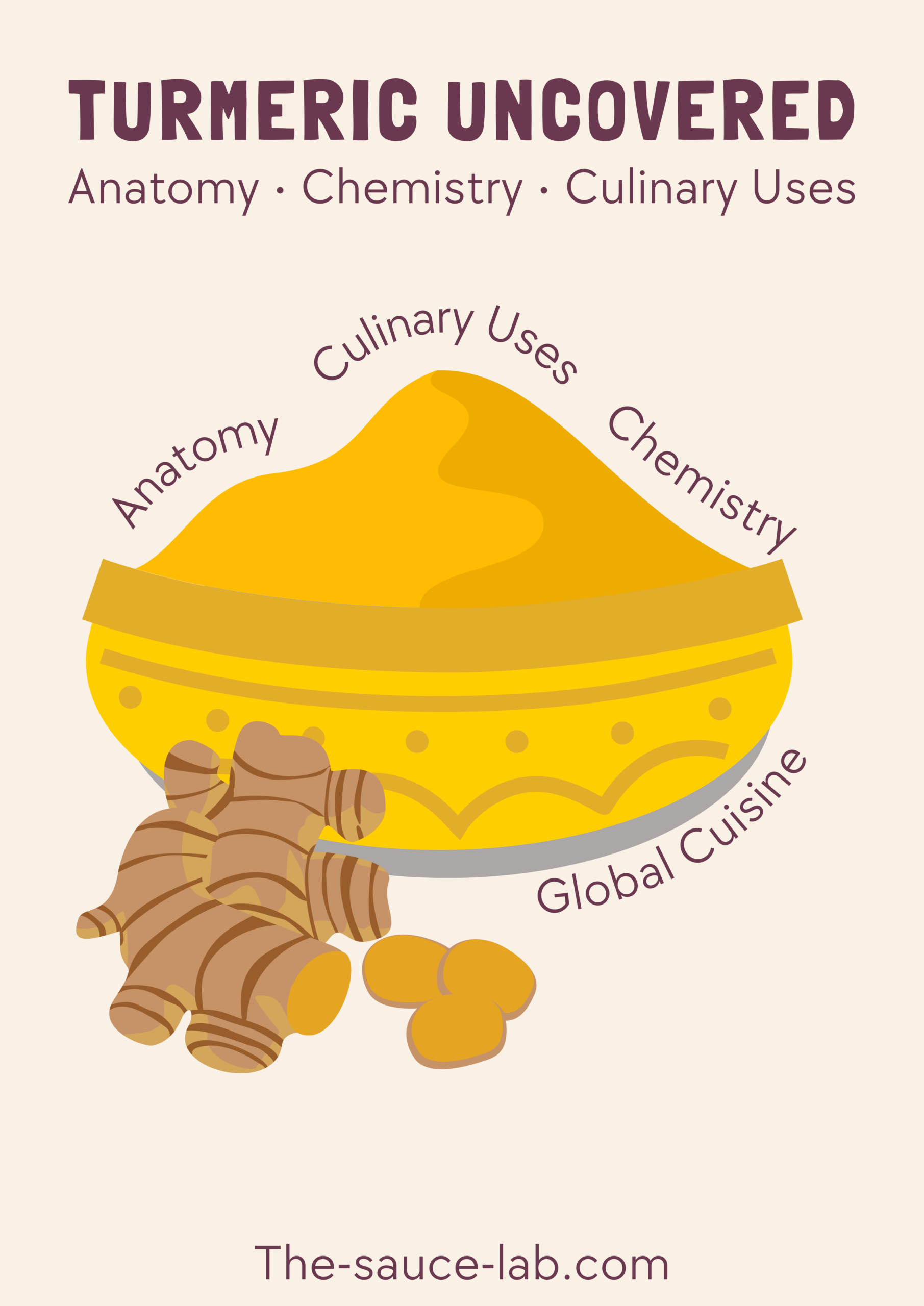
Turmeric is a spice with a deep, golden-orange spice comes from underground stems, called rhizomes. It is used worldwide for home cooking, in traditional medicine, in the food industry, or as a biopesticide. Cooking-wise, it is used in spice mixes, curry powders, sauces, gravies, pickles, and relishes. Because of its golden-orange colour, it is also used as a colouring agent. It has a distinct earthy, spicy, and citrus flavour (1).
Turmeric (Curcuma longa) belongs to the Zingiberaceae family, which also includes ginger (Zingiber officinale), green cardamom (Elettaria cardamomum), black cardamom (Amomum subulatum), greater galangal (Alpinia galanga), lesser galangal (Alpinia officinarum), and grains of paradise (Aframomum melegueta).
Turmeric is cultivated mainly in India (approximately 90 percent of all turmeric powder), but also in China, Thailand, Cambodia, Malaysia, Indonesia, and the Philippines (1).
Anatomy of the Turmeric Plant
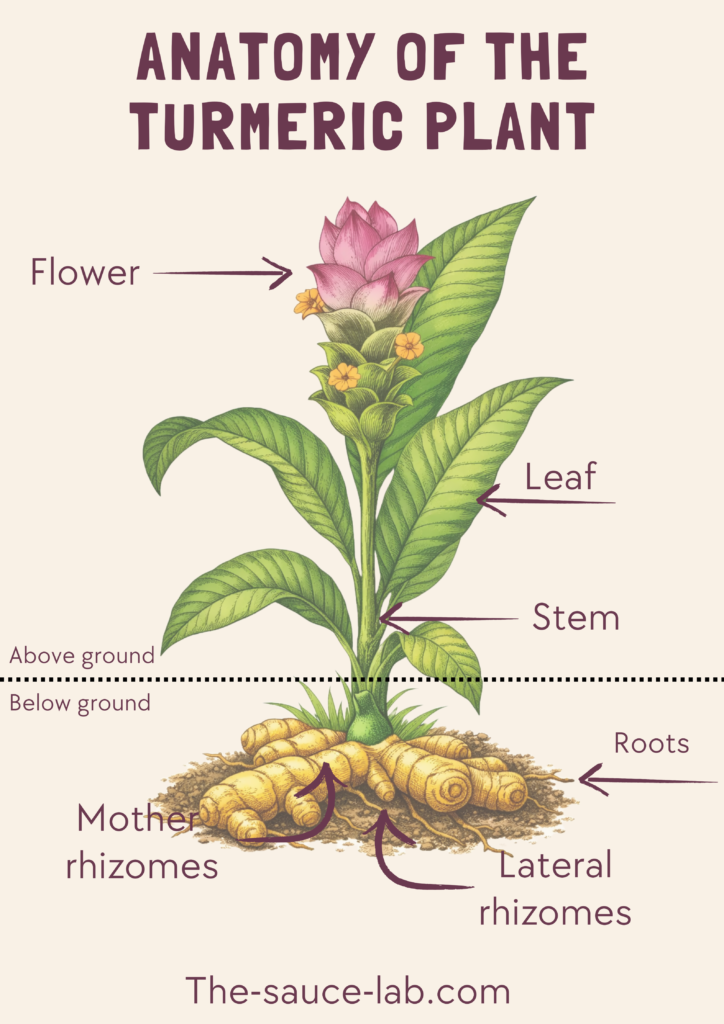
Turmeric (Curcuma longa) is a perennial plant grown as an annual crop, developing from a below-ground rhizome. The above-ground part of the plant can reach 60–100 cm in height and has a pseudostem created by overlapping 7–12 green leaves. The plant has 2 to 3 tillers and a central inflorescence with white and green bracts (1).
The below-ground part is highly branched and consists of a mother rhizome and lateral finger-like rhizomes. They have an orange, yellow, to brown colour and are the part of the plant that is harvested and used in cooking. The rhizomes can be used fresh, which is common in South and Southeast Asia, or they can be harvested, boiled, dried, and ground into turmeric powder (1).
Types and Varieties of Turmeric
Turmeric has different varieties based on yield, curcumin content, aroma, and size of the rhizomes (8,9).
Some cultivar groups
- Alleppey Supreme turmeric (India) – Reddish-orange in colour with relatively high curcumin content (~5.5%)
- IISR-Kedaram turmeric (India) – Reddish-yellow in colour with curcumin levels of ~5.7% and oleoresin content of 14.0%
- Madras turmeric (India) – Lighter in colour with a milder flavour and curcumin levels of ~2.0%
- Erode turmeric (India) – Bright yellow colour with curcumin levels between 2–4%. It is a Geographical Indication (GI)-tagged variety from India with a strong aroma.
The Versatility of Turmeric
Forms and Processing
Turmeric is used in multiple main forms, each with different colour, stability, bioactivity, and flavour. These main forms are:
- Fresh turmeric – Turmeric can be used fresh, like ginger. It is typically sliced, grated, or pounded into a paste and used in curries, rice dishes, and soups.
- Dried and powdered turmeric – This is the main form in which turmeric is used. It is first boiled for approximately an hour in an alkaline solution and then sun-dried for around two weeks, until the moisture content drops below 10%. After this drying period, it is ground into a fine powder and packaged.
Interestingly, curcumin can have different staining power depending on the conditions. In acidic environments, its colour is yellow, while in alkaline environments it can turn red to orange (2).
- Turmeric oleoresin – Widely used in the food industry for colour and aroma. It is a solvent extract of powdered turmeric and contains concentrated curcumin, oils, resins, fatty acids, and other active ingredients. The oleoresin is red to orange in colour and is blended with vegetable oil or propylene glycol.
- Turmeric oil – Produced by steam distillation of turmeric powder. It is pale yellow in colour with a pleasant odour. Its main culinary use is in processed foods, sauces, pickles, and similar products.
- Turmeric leaves – Leaves from the turmeric plant are also used in western India. They are not consumed directly but are used to wrap a filling that is then steamed. They impart a distinctive aromatic sweet fragrance, quite different from that of the rhizomes (1,2).
Culinary Usage of Turmeric
Turmeric is a cornerstone of South Asian, Southeast Asian, Middle Eastern, and East African cuisines. It is rarely used alone; instead, it forms the base of spice blends such as curry powder, garam masala, and ras el hanout (2).
Turmeric gives a mustard-like, pungent, earthy flavour to foods. Its main use is in savoury dishes, but it can also be used in desserts such as sfouf and patoleo. Turmeric powder is the principal ingredient (40–50%) in curry powder and contributes both colour and aroma. It is used to season savoury dishes with meat, fish, and vegetables.
Common culinary applications include:
- Primary form of use
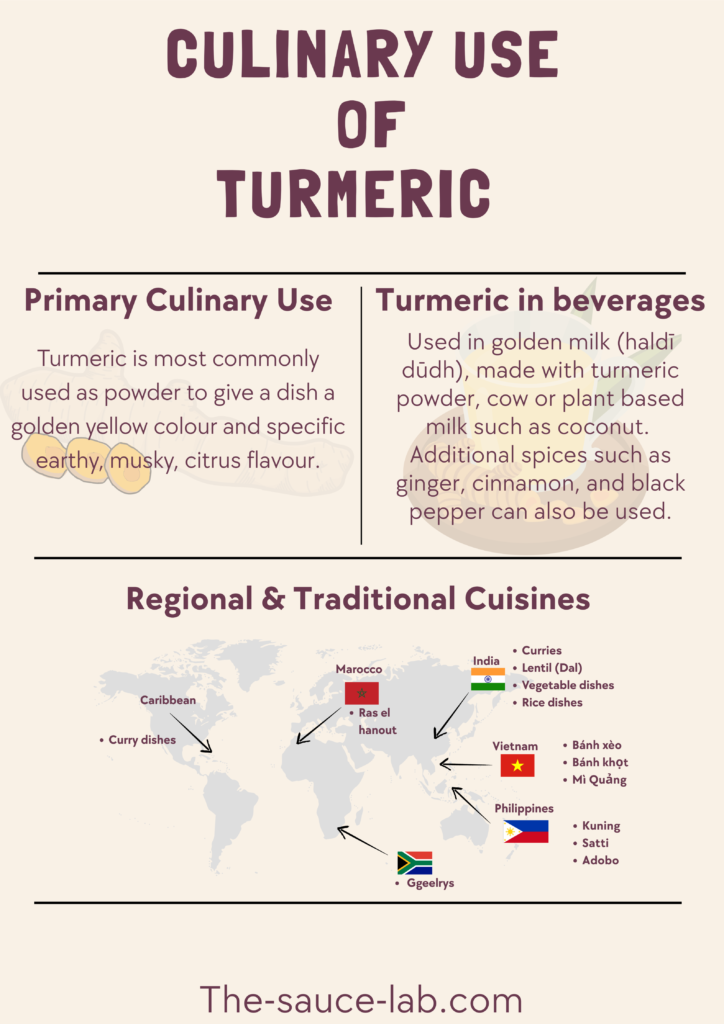
- Turmeric is most commonly used as a powder to give dishes a golden-yellow colour and a specific earthy, musky, citrus flavour.
- Food and beverage applications
- Turmeric is used for its colour in canned beverages, baked goods, dairy products, ice cream, yoghurt, cakes, orange juice, biscuits, popcorn, cereals, and sauces.
- Food colouring
- Approved in both the US and EU as a food colouring under E100.
- Turmeric oleoresin is also used in oil-containing products.
- Often combined with annatto (E160b) to colour various foods.
- Regional and traditional cuisines
- Morocco: One of the ingredients in the spice blend ras el hanout.
- South Africa: Used to colour boiled white rice (geelrys), alongside cinnamon and raisins.
- Vietnam: Used in dishes such as bánh xèo, bánh khọt, and mì Quảng.
- Cambodia: Fresh turmeric is a component of kroeung curry paste, used for dishes such as fish amok.
- Indonesia: Turmeric leaves are used in curries like rendang, while turmeric powder is used in sate Padang.
- Philippines: Used in rice dish kuning, grilled meat skewers satti, and some variants of adobo.
- Thailand: Fresh turmeric is widely used in southern Thai cuisine, including yellow curry and turmeric soup (kaeng som).
- India: Used daily in curries, lentils (dal), vegetables, and rice dishes, both fresh and as dried powder.
- Bangladesh and Nepal: Used similarly to Indian cuisine.
- Middle East: Used as a colouring and flavouring agent in rice dishes, stews, and spice blends.
- Caribbean: Common in curry dishes, especially in Trinidad and Guyana.
- Europe and North America: Used mainly as a spice and natural colourant in processed foods and health-oriented products.
- Beverages
- Used in turmeric or golden milk (haldī dūdh), traditionally made with turmeric powder and milk or plant-based alternatives.
Chemistry of Turmeric Colour and Flavour
Curcumin and Curcuminoids:
The Colour Behind Turmeric
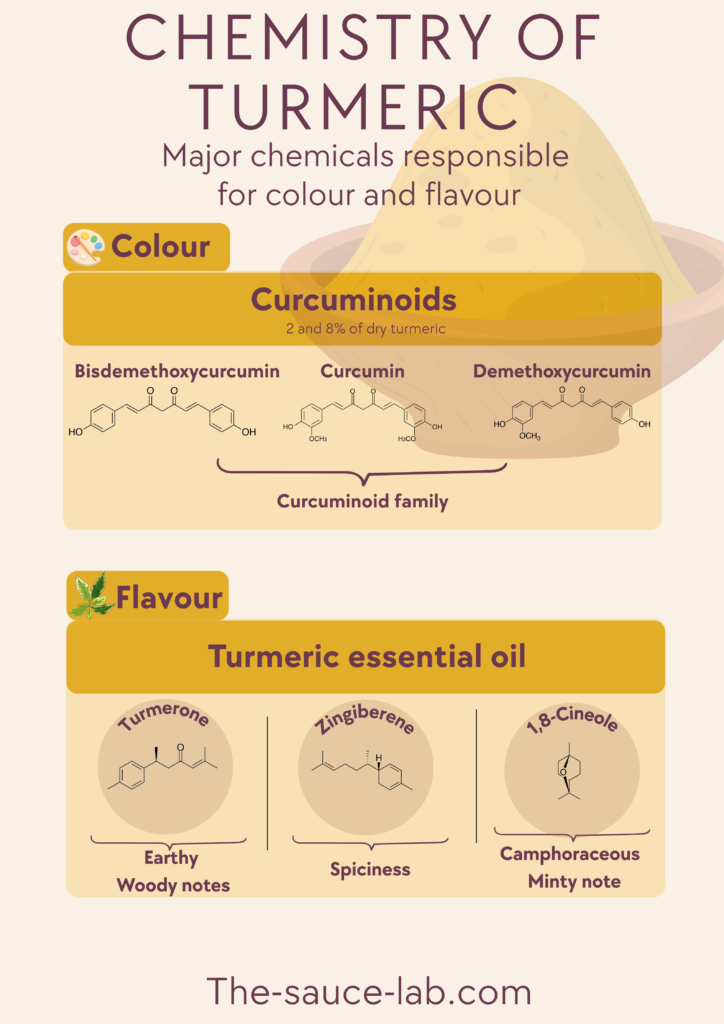
Turmeric is used worldwide primarily because of its vibrant yellow-orange colour, which comes mainly from the pigment molecule curcumin (1,2).
Curcumin is a colouring compound found in turmeric and related Curcuma species. It is a bright yellow polyphenol with the chemical formula C₂₁H₂₀O₆. Curcumin works together with other curcuminoids to give turmeric its characteristic colour.
The main curcuminoids present in turmeric rhizomes are:
- Curcumin (diferuloylmethane, curcumin I)
- Demethoxycurcumin (curcumin II)
- Bis-demethoxycurcumin (curcumin III)
Curcumin content varies depending on the variety and ranges between 2 and 8%.
Aroma Matters Too: The Role of Turmeric Oil
Properly dried turmeric retains a significant proportion of its essential oil, which is released during grinding or cooking. The aroma and flavour come mainly from sesquiterpenes such as ar-turmerone, turmerone, zingiberene, curcumenone, curcumenol, and isoprocurcumenol, as well as monoterpenes. These compounds give turmeric its warmth, earthiness, and woody aroma.
What About Cooking?
Curcuminoids are heat-stable and insoluble in water but readily soluble in oil and fat. Cooking turmeric in oil or fat helps release its colour, aroma, and flavour into the dish (2).
Nutritional Values, Biological Properties, and Toxicity
Nutritional values (100 g dried turmeric powder, approximate) (1)
| Constituent | Quantity per 100 g |
| Water (g) | 6.0 |
| Food energy (kcal) | 390 |
| Protein (g) | 8.5 |
| Fat (g) | 8.9 |
| Carbohydrate (g) | 69.9 |
| Ash (g) | 6.8 |
| Calcium (g) | 0.2 |
| Phosphorus (mg) | 260 |
| Sodium (mg) | 30 |
| Potassium (mg) | 2000 |
| Iron (mg) | 47.5 |
| Thiamine (mg) | 0.09 |
| Riboflavin (mg) | 0.19 |
| Niacin (mg) | 4.8 |
| Ascorbic acid (mg) | 50 |
Biological Activities
Extensive research suggests turmeric and curcumin exhibit (3,5,6,7):
- Antioxidant
- Anti-inflammatory
- Antimicrobial (antibacterial, antifungal, antiviral)
- Antimutagenic
- Anticancer / antitumour
- Hepatoprotective
- Cardioprotective
- Antidiabetic / hypoglycaemic
- Neuroprotective
- Antidepressant
- Antiarthritic
- Immunomodulatory
- Gastroprotective
- Wound healing
- Lipid-lowering
- Digestive stimulant
- Respiratory protective
- Antifibrotic
- Insect-repellent
- Chemopreventive
Piperine from black pepper increases the bioavailability of curcumin by up to 20-fold by inhibiting glucuronidation in the liver and intestines (4,7).
⚠️ Safety Note
Turmeric is generally considered safe at culinary doses. High-dose supplementation may cause:
- Gastrointestinal discomfort
- Increased gallbladder contraction
Turmeric has sometimes been adulterated with toxic substances to enhance colour, including lead-based compounds such as red lead or lead chromate. This has led to FDA import alerts and international recalls due to lead toxicity.
Overall, turmeric adulteration remains a significant global public health concern.
References:
1. Peter, K. V. (Ed.) (2001). Handbook of herbs and spices. Woodhead Publishing Limited, Abington Hall, Abington, Cambridge CB1 6AH, England; CRC Press LLC, Boca Raton, FL, USA.
2. Farrimond, S. (2018). The science of spices. DK (Dorling Kindersley), London, United Kingdom.
3. MacAller, N. (2016). Spice Health Heroes: Unlock the power of spice for flavour and wellbeing. Jacqui Small (Quarto Publishing Group UK), London, United Kingdom.
4. Shoba, G., et al. “Influence of Piperine on the Pharmacokinetics of Curcumin.” Planta Medica, 1998
5. Hewlings, S. J., & Kalman, D. S. “Curcumin: A Review of Its Effects.” Foods, 2017.
6. Gupta, S. C., et al. “Multitargeting by Curcumin.” Trends in Pharmacological Sciences, 2013.
7. El-Saadony, M. T., Saad, A. M., Mohammed, D. M., Alkafaas, S. S., Ghosh, S., Negm, S. H., Salem, H. M., Fahmy, M. A., Mosa, W. F. A., Ibrahim, E. H., AbuQamar, S. F., & El-Tarabily, K. A. (2022). Curcumin, an active component of turmeric: Biological activities, nutritional aspects, immunological properties, bioavailability, and human health benefits – a comprehensive review. Frontiers in Nutrition, 9, Article 907063.
8. Turmeric World . By colours & shape. Turmeric World. Available at: https://turmericworld.com/by-colors-shape/ [Accessed 25-28 Dec. 2025].
9. Directorate of Arecanut and Spices Development (n.d.). Varieties of turmeric. Spice Nurseries. Available at: https://spicenurseries.in/varieties-list.php?View=varieties&PL=141b005d80aebac02340fQ3f0a66f209beUxMDAwOQ [Accessed 25-28 Dec. 2025].