
Preserved Lemons: History, Technique, and Flavour
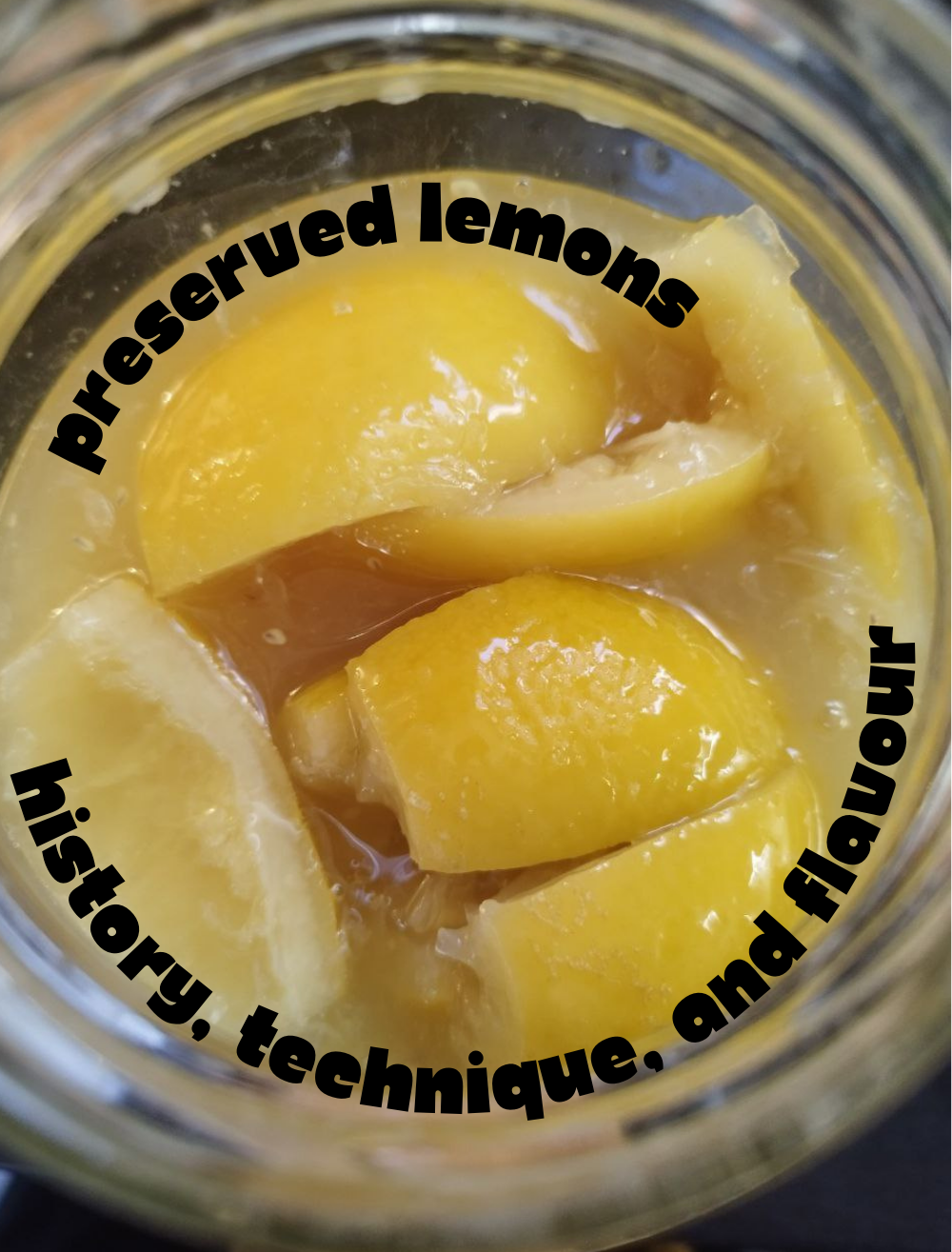
🍋 Or how salt + citrus + time = flavour
Introduction
Preserved lemons are simple to make, yet incredibly versatile. It is a staple across Africa, Middle Eastern cuisine, Indian subcontinent and parts of Asia. They is prized because of its unmistakable flavors: salty, citrusy, floral, deep, round and mellow.
Fresh lemons are sharp and bright, while preserved lemons are soft and mellow with intense aroma and flavour. They have the smell and taste of candies lemons, but better.
They are capable of elevating anything ranging from Moroccan tagines to meat, seafood, salads, dressings and even cocktails.
🌍 Preserved lemons History: From Africa to the World
Food preservation was used even around 12,000 B.C., where Eastern cultures dried food in the sun. Since then, many different strategies for food preservation have been developed depending on the type of food available. (1)
Lemons were preserved for the same reason all other things are preserved—to store and consume them after their season.
One of the early pieces of evidence for preserved lemons came from physician named Ṣalāh ad‐Dīn named Abū al-Makārim Hibat Allāh ibn Zayn al-Dīn Ibn Jumay or shortly Ibn Jumay (todays Egypt). He wrote the medical cookbook entitled “On Lemon, it’s Drinking and Use” (2) where he described the process of making preserved lemons. Interestingly, the exact process of making them back then is basically unchanged until now:
Take lemons that are fully ripe and of bright yellow colour; cut them open without severing the two halves and introduce plenty of fine salt into the split; place the fruits thus prepared in a glass vessel having a wide opening and pour over them more lemon juice until they are completely submerged; now close the vessel and seal it with wax and let it stand for a fortnight in the sun, after which store it away for at least forty days; but if you wait still longer than this before eating them their taste and fragrance will be still more delicious and their action in stimulating the appetite will be stronger.
– Exurb from “Hesperides: A History of the Culture and Use of Citrus Fruits” (3), from the original text, “On Lemon, its Drinking and Use” by Ibn Jumay, 12th century (see present in (4))
Even though the first written evidence comes from Africa, lemons were also present in the Indian subcontinent, since there is evidence that the precursors for the modern lemons, Citron and Bitter lemons (jambīla for citrus/lemon), were first mentioned in a Sanskrit text and Ayrvedic writings dated back to the 7th century BC (5).
Nowadays they are widely used in Africa, the Middle East, Indian subcontinent, Mainland Southeast Asia, etc.
In Morocco, no kitchen is complete without a jar of preserved lemons— “l’ḥamd mraqqad” (الْحَامْضْ مُرَقَّد).
🔬 The Science of Preserved Lemons
Preserved lemons rely on two key ingredients and their effects— salt and acid. Together, they shape the lemons texture, smell, taste and safety profile.
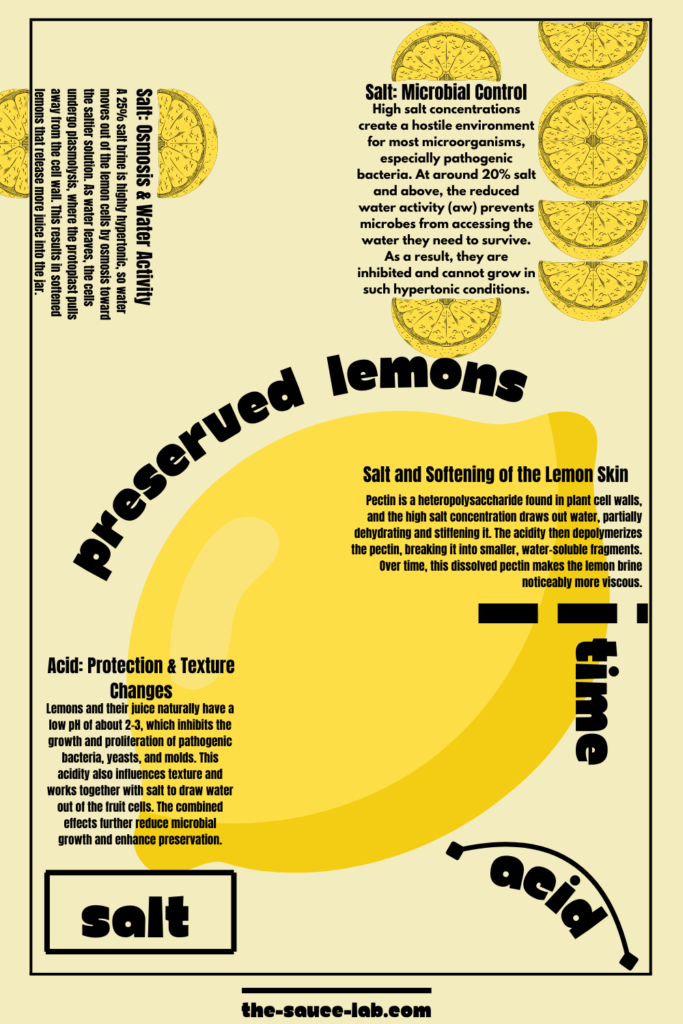
a. Salt: Osmosis & Water Activity
The preserved lemons are brined in a saltwater solution. For this, I have used 25% salt concentration (aw< 0.85)2. This makes the solution highly hypertonic– far saltier than the inside of the lemon cells.
This hypertonic solution will cause the loss of water present in the cells of the lemons. This process of movement of water is called osmosis, and it’s defined as the movement of water through a membrane from regions with more water (less solute) to the side of the membrane where there is less water (more solute), until both sides are balanced (6, 11).
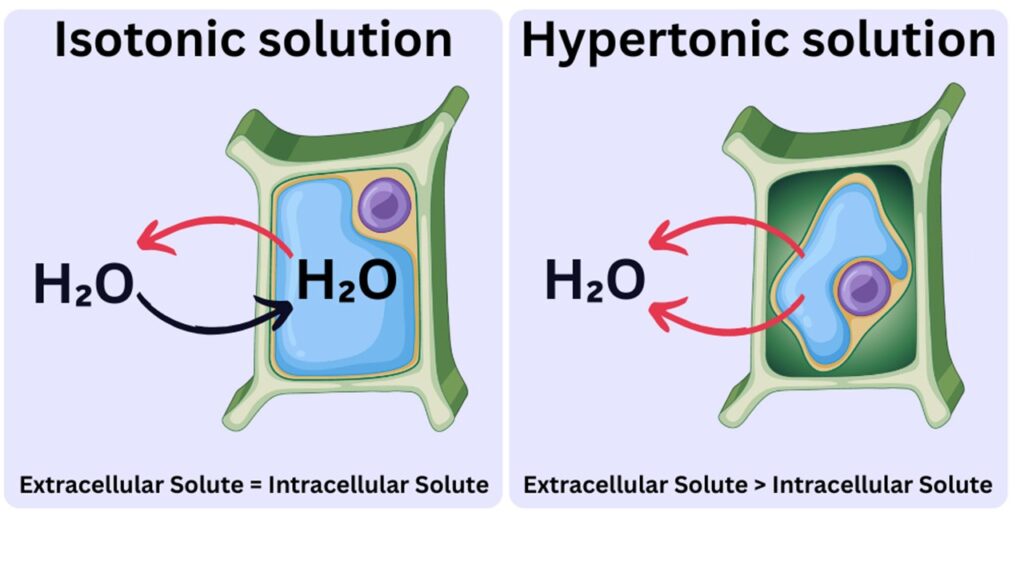
The loss of water from the plant cell makes it undergo plasmolysis— it shrinks, causing the protoplast (plasma membrane + cytoplasm and organelles) to pull themselves away from the cell wall (6, 11).
The result from the osmosis is softening of the lemons, while they releases more of it juices into the jar.
b. Salt: Microbial Control
High salt concentration is a very hostile environment for microorganisms such as pathogenic bacteria. Most of them are inhibited and cannot thrive in hypertonic solutions of 20% salt and higher (7,8). The effect of the salt is the reduction of the activity of water (aw), making the water unavailable to microbes.
c. Salt and Acid: Softening of the Lemon Skin
Pectin is a heteropolysaccharide1 found in the plant cell wall. Since the high concentration of salt will extract the available water from the plant cell, this will cause partially dehydration of pectin, making it more rigid. Additionally, the acidity will depolymerize pectin, cutting the long polymer molecule into smaller fragments making them water soluble. This is also why, after some time, the brine of the lemons becomes quite viscous.
d. Acid: Protection & Texture Changes
Lemons and their juice have a naturally low pH (pH ~ 2-3). This level of acidity can inhibits the growth and multiplication (proliferation) of pathogenic bacteria, yeast and mold (7,8). Acidity also affects texture. It further inhibits microbial growth, working synergistically with salt, drawing water out of the fruit cells (7,8).
🍋 What Do Preserved Lemons Taste Like?
- They are pretty salty– wash them before using!
- Sweet and very citrusy, but mellow– candy like in some way.
- Floral, due to oil molecules in the peel.
For preserved lemon you use the peel, not so much the flesh, unlike the fresh lemons.
🛒 Choosing the Best Lemons
For best results:
- The use of organic lemons is ideal (presumably far less pesticides).
- Any kind of lemon will work just fine.
- Try to source thin-skinned lemons
🧂 Ingredients for Classic Preserved Lemons (1 Jar ≈ 3 L)
- 6–8 small-to-medium lemons (for they were 1345g)
- 25% salt (for 1345g of lemons it will be 269 g of salt (1345 x 0.25 = 269)
- Fresh lemon juice from 1-2 lemons (out of those above)
- A clear jar
🍋 Step-by-Step: How to Make Preserved Lemons
- Prep the Lemons
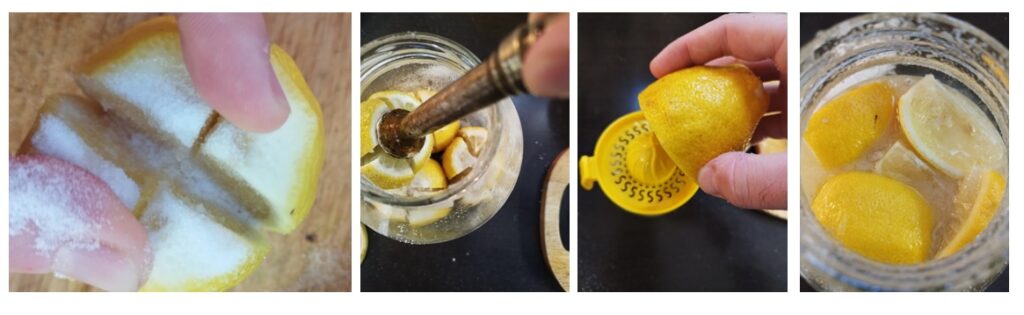
Wash and scrub the lemons with cold water and mild soap. This alone will remove surface pesticides to some extent (9, 10). Trim the ends and slice the lemons crosswise, but don’t cut all the way through— leave part of the bottom intact. - Salt Generously
Open each lemon and pack 1-2 tablespoons of the salt in between the cuts. Place them into the jar and push them firmly so that they release their juice. - Pack the Jar
Pack the first row of lemons tightly and put some additional salt on them. Continue until you have packed all but 1-2 lemons. - Add Lemon
Squeeze the fresh lemon juice from 1-2 lemons and pour the liquid into the jar. Make sure that all the lemons are submerged in. Preservation requires the full coverage of the lemons. - Seal and Wait
Tightly close the jar and leave at room temperature:
- First 3–5 days: Stir or shake daily to dissolve and redistribute the salt.
- 3–4 weeks: Let it in a cool, dark place.
They are ready when:
- The smell is sweet and mellow
- The peel becomes translucent and soft
- The juice becomes syrupy
They will anywhere between 6 – 12 months. I keep mine at room temperature.
Note: with that much salt the lid of the jar will rust. The thing I do is to cover the jar opening with plastic wrap and put the lid on top, thus preventing the rust from falling over the lemons.

🥄 How to Use Preserved Lemons
• Traditional dishes with preserved lemons
- Moroccan chicken or lamb tagine (tagine – طاجين) — traditional North African dish cooked with chicken or lamb, olives, spices (ginger, cumin, turmeric, cinnamon, saffron, coriander seed, caraway seed, paprika, chili, etc) and preserved lemons.
- Very interesting variation of preserved lemons can be seen in the Indian subcontinent— Nimbu ka Achar (Indian Lemon Pickle). It consists of lemons or other citruses combined with different spices like turmeric, fennel, cumin, cardamon, black pepper, cloves, chilli, nigella seeds and asafoetida.
- Preserved lemons are also used in Cambodian cuisine. It’s one of the ingredients for traditional sour chicken soup called ngam nguv (ស្ងោរមាន់ង៉ាំង៉ូវ).
• Non-traditional uses of preserved lemons
- Couscous and grain salads– excellent because of their mellow citrusy flavour.
- Roasted vegetables– perfect with carrots, cauliflower and zucchini.
- Dressings and vinaigrettes – finely chop the peel for a mellow acid-salty note and some texture.
- Mayonnaise and mayo derivatives – combine a small amount for a complex lemony lift.
- Tahini-based sauces– the salty citrus will cut through the richness and will make it more vibrant
- Grilled fish or seafood – pairs beautifully with acid and mellow taste of preserved lemon peels.
- Compound butter – excellent additive in combination with herbs.
- Hummus or labneh – fold in chopped peel for added tang, aroma and citrus vibe.
- Cocktails (very tiny amounts!) – use the brine or a very finely cut zest as a savory citrus accent.
🌶 Popular Variations Of Preserved Lemons
• Moroccan (Traditional)
Just lemons, salt, and lemon juice.
• Spiced
With additional spices:
Turmeric, Fennel, Cumin, Cardamom, Black pepper, Cloves, Chili, Nigella seeds, Asafoetida, Bay leaves, Cinnamon stick, Peppercorns, Coriander seeds, Chili, Cloves, Rosemary, Thyme, etc.
Note: My recommendation is to start with traditional lemons first and then experiment with adding one or two spices at a time to see which combinations you like the best
⚠️ Safety Notes
- To prevent spoilage, always keep lemons fully submerged under the liquid line.
- If mold forms on the surface, discard the batch.
- If the content of the jar smells off, discard the batch.
- Use clean utensils to avoid contamination.
Final Thoughts
Preserved lemons are a simple way to add depth, brightness, and character to a dish. Even though it takes weeks for them to become ready, it is a passive process— you just prepare them, then sit and play the waiting game. Ones you have your preserved lemons ready, you can start experimenting with dishes from near and far, explore different cuisines or just put them in your cocktail. Enjoy the unique flavour they bring!
Preserved Lemons
Ingredients
Method
- Wash and scrub the lemons with cold water and mild soap.

- Trim the ends and slice the lemons crosswise.
- Open each lemon and pack 1-2 tablespoons of the salt in between the cuts.
- Place them into the jar and push them firmly so that they release their juice.
- Pack them, together with some additional salt around them.
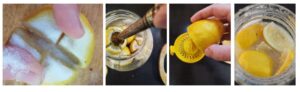
- Squeeze the fresh lemon juice from 1-2 lemons and pour the liquid into the jar. Make sure that all the lemons are submerged in.
- Tightly close the jar and leave at room temperature for at least 2-3 weeks
References:
1. Nummer, B. A., PhD. (2002). Historical origins of food preservation. National Center for Home Food Preservation. https://nchfp.uga.edu/publications/nchfp/factsheets/food_pres_hist.html
2. Ibn Jumay. (12th century). On Lemon, Its Drinking and Use. [Arabic medical treatise].
3. Tolkowsky, Samuel. Hesperides: A History of the Culture and Use of Citrus Fruits. London: J. Bale, Sons & Curnow, Ltd., 1938.
4. Snodgrass, Mary Ellen. Encyclopedia of Kitchen History. Routledge, 2004. ISBN 10: 1579583806; ISBN 13: 978 1579583804
5. Panara, K., & Nishteswar, K. (2013). Confirmation of the botanical source of Beejapoora: A synonym based study. Journal of Biological and Scientific Opinion, 1(4), 389–393. https://doi.org/10.7897/2321‑6328.01423
6. Alberts, B., Johnson, A., Lewis, J., Raff, M., Roberts, K., & Walter, P. (2015). Molecular Biology of the Cell (6th ed.). New York: Garland Science.
7. Montville, T. J., & Matthews, K. R., with Kniel, K. E. (2012). Food microbiology: An introduction (3rd ed.). ASM Press. https://doi.org/10.1128/9781555817206
8. Occurrence, Growth and Survival | Advisory Committee on the Microbiological Safety of food
9. Yang, S.-J., Mun, S., Kim, H. J., Han, S. J., Kim, D. W., Cho, B.-S., Kim, A. G., & Park, D. W. (2022). Effectiveness of different washing strategies on pesticide residue removal: The first comparative study on leafy vegetables. Foods, 11(18), 2916. https://doi.org/10.3390/foods11182916
10. Aslantas, S., Golge, O., González-Curbelo, M. Á., & Kabak, B. (2023). Determination of 355 pesticides in lemon and lemon juice by LC-MS/MS and GC-MS/MS. Foods, 12(9), 1812. https://doi.org/10.3390/foods12091812
11. Institute of Medicine (US) Committee on Strategies to Reduce Sodium Intake. (2010). Strategies to reduce sodium intake in the United States. Edited by J. E. Henney, C. L. Taylor, & C. S. Boon. Washington, DC: National Academies Press. https://doi.org/10.17226/12818
Additional remarks
1. A heteropolysaccharide is a complex sugar polymer made from two or more different types of sugar (monosaccharide) units linked together.
2. Water availability (aw)- measurement of the amount of water present in the food available for microorganisms to use. It ranges from 0 (completely dry food) to 1.0 (pure water). Bacteria, yeasts, and molds, need water to grow and reproduce. Even if a food looks “wet”, if the water is bound up by sugar, salt, or other solutes, microbes can’t access it, and growth and reproduction is inhibited. Limiting the amount of available water means reducing the water activity, usually by either adding salt or sugar (binds water molecules) or drying or dehydrating the food.